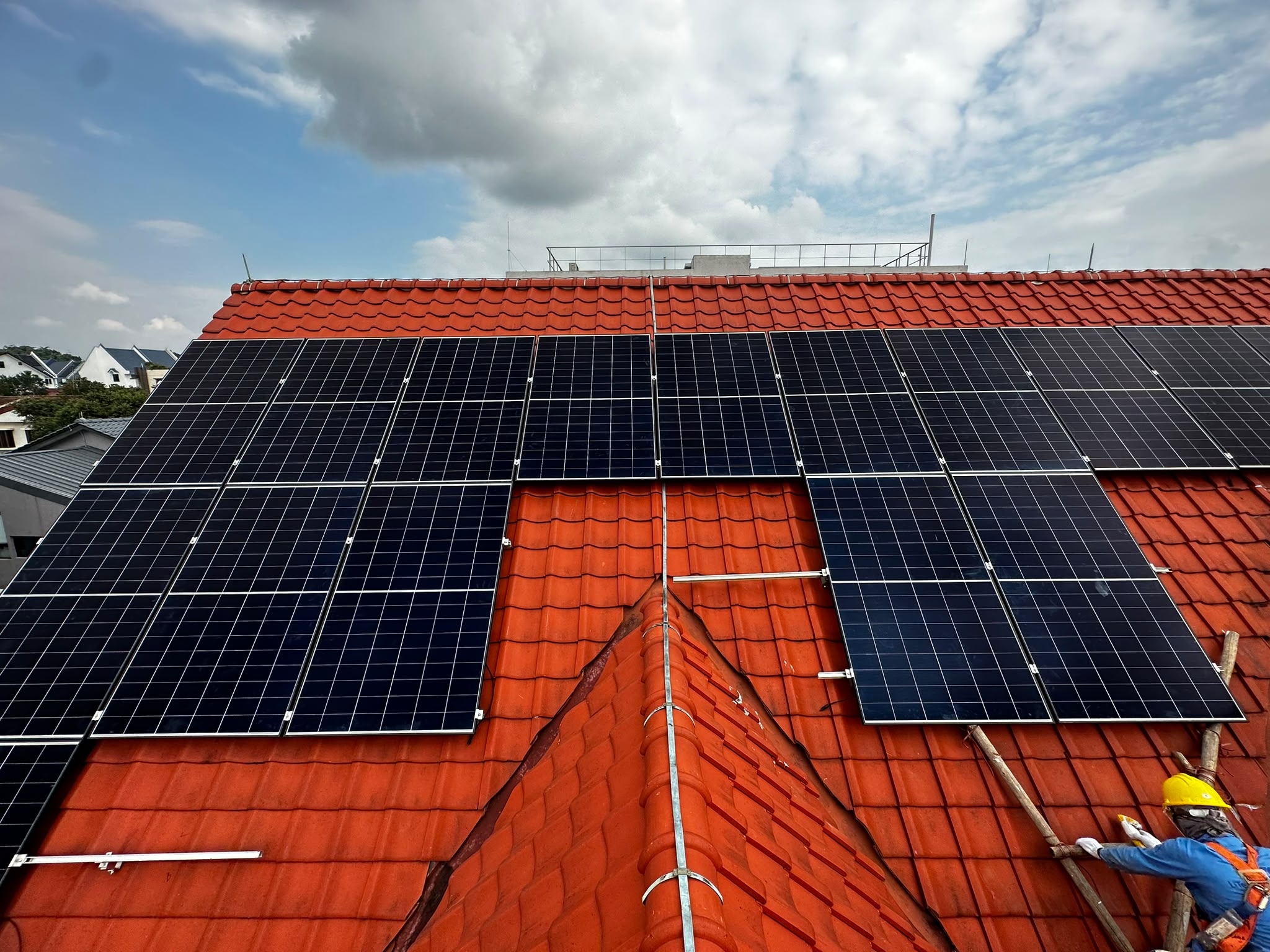
When homeowners ask whether their roof is “good enough” for solar, the concern usually comes down to roof angle, direction, and sun exposure. The good news? In Singapore, solar is far more forgiving than most people expect.
Drawing on common guidance from industry discussions on rooftop suitability, here’s what you need to know -- simply and quickly.
Yes — but only slightly.
Because Singapore sits near the equator, the sun travels high across the sky throughout the year. This means:
Most residential roofs in Singapore already fall within the optimal tilt range of about 15°–30°.
The key design consideration is proper spacing to prevent self-shading - something addressed during a professional site survey.
Shading is more important than roof angle because solar panels are connected in series in “strings”, meaning the panels in a string must all operate at the same current. If even one panel is partially shaded, its output drops, and that limits the output of the entire string to the level of the most shaded panel - much like the weakest link in a chain. By comparison, a sub-optimal roof angle usually causes only a small, predictable reduction in annual output.
For homes with multiple roof angles or orientations, good system design becomes critical. Panels on different roof faces are typically arranged into separate strings, so that shading or lower output on one section does not drag down the performance of another. This allows each roof plane to operate closer to its own optimal output, preserving overall system performance even on complex roof layouts.
Want to know how your specific roof performs?
Schedule a site survey with us to get a tailored assessment of your home’s solar potential and expected savings.
When homeowners ask whether their roof is “good enough” for solar, the concern usually comes down to roof angle, direction, and sun exposure. The good news? In Singapore, solar is far more forgiving than most people expect.
Drawing on common guidance from industry discussions on rooftop suitability, here’s what you need to know -- simply and quickly.
Yes — but only slightly.
Because Singapore sits near the equator, the sun travels high across the sky throughout the year. This means:
Most residential roofs in Singapore already fall within the optimal tilt range of about 15°–30°.
The key design consideration is proper spacing to prevent self-shading - something addressed during a professional site survey.
Shading is more important than roof angle because solar panels are connected in series in “strings”, meaning the panels in a string must all operate at the same current. If even one panel is partially shaded, its output drops, and that limits the output of the entire string to the level of the most shaded panel - much like the weakest link in a chain. By comparison, a sub-optimal roof angle usually causes only a small, predictable reduction in annual output.
For homes with multiple roof angles or orientations, good system design becomes critical. Panels on different roof faces are typically arranged into separate strings, so that shading or lower output on one section does not drag down the performance of another. This allows each roof plane to operate closer to its own optimal output, preserving overall system performance even on complex roof layouts.
Want to know how your specific roof performs?
Schedule a site survey with us to get a tailored assessment of your home’s solar potential and expected savings.