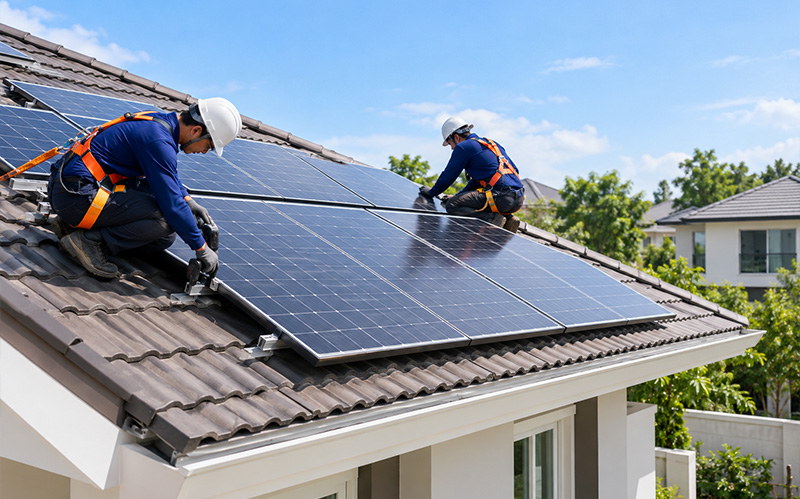
Singapore receives abundant sunlight year-round, making rooftop solar a practical option for many residential and commercial properties. However, strong sunlight also raises panel temperatures, which can affect electricity generation.
So how does heat affect solar panels, and should property owners worry about Singapore's tropical climate? While higher temperatures can reduce efficiency, not every fluctuation in electricity generation indicates a problem. At Energio, we assess how heat influences solar output alongside site-specific conditions, helping property owners understand expected system performance and recognise changes that may warrant further investigation.
When exploring how heat affects solar panel performance, we look at sunlight intensity and cell temperature as two separate factors. Stronger sunlight generally supports higher electricity generation, but rising cell temperatures can reduce conversion efficiency.
That is why we do not judge a system’s performance based on how sunny the day is alone. Instead, we assess whether the system's electricity output matches the available solar irradiance, panel temperature, and other operating conditions.
One misconception we often encounter among property owners is that solar panels operate at the same temperature as the surrounding air. In reality, solar modules absorb heat when exposed to sunlight, so their operating temperatures can be considerably higher than the ambient temperature. For instance, even when Singapore's air temperature is 32°C, the panels themselves may be significantly hotter.
Their actual temperature depends on several conditions:
We consider these conditions during site assessments because two buildings experiencing similar weather may have different module operating temperatures.

One specification we examine when evaluating solar modules is the power temperature coefficient. It indicates how much rated power changes for every degree Celsius increase in cell temperature above the standard test reference of 25°C.
For example, a panel with a temperature coefficient of -0.35%/°C loses approximately 0.35% of its rated power for every degree above 25°C, assuming other conditions remain constant. This represents a gradual reduction in output.
We would not recommend selecting panels solely because they have a favourable temperature coefficient. Available roof space, module efficiency, reliability, warranties, and overall system economics remain equally relevant.
When determining how heat affects solar panels, we also examine the installation environment. A pitched residential roof and a large commercial metal roof can present different airflow, shading, structural, and access conditions.
Our approach to panel mounting balances practical ventilation with structural suitability, weatherproofing, and installation requirements. For instance, increasing clearance beneath modules may improve airflow, but the mounting arrangement must still account for wind loads, roof geometry, and maintenance access.
As a solar installation company, we prioritise a suitable system layout rather than simply maximising the number of panels installed. Installing more panels is not necessarily beneficial if the layout introduces avoidable shading, restricts maintenance access, or compromises the suitability of the mounting arrangement.
Although higher temperatures can reduce conversion efficiency, Singapore's solar potential remains promising. At Energio, we assess expected electricity generation based on actual operating conditions, including sunlight exposure, cloud cover, shading, and equipment performance.
For property owners planning to install solar panels in Singapore, the priority is determining whether the system can generate enough usable electricity to justify the investment. This requires evaluating roof suitability, electricity consumption patterns, and system capacity, not just temperature-related efficiency losses.
Normal heating and cooling are expected during solar panel operation. However, repeated thermal expansion and contraction can contribute to material fatigue over time. Sustained elevated temperatures may also accelerate certain forms of solar cell degradation.
We distinguish these gradual effects from localised hot spots, where a particular section of a module becomes significantly hotter than surrounding areas. Hot spots may arise from partial shading, soiling, damaged cells, or electrical faults. They should not automatically be attributed to Singapore's warm weather.
Through system performance monitoring, we can examine generation trends and identify unusual changes that may justify further inspection. Monitoring data alone does not establish the cause, but it provides a useful starting point for troubleshooting.
Managing the effects of heat begins with designing a solar PV system around the property's actual operating conditions. At Energio, we consider how roof characteristics, equipment specifications, and installation arrangements influence temperature-related efficiency losses and long-term generation.
Understanding how heat affects solar panels helps property owners set realistic expectations for electricity generation and recognise when performance changes may require further investigation. While higher temperatures can reduce efficiency, a well-designed solar PV system can still deliver meaningful long-term value in Singapore's tropical climate.
By working with an experienced solar company in Singapore, property owners can make informed decisions about panel selection, roof suitability, system capacity, and expected generation. Accounting for these factors during site assessment and system planning helps optimise solar performance, support long-term reliability, and maximise potential electricity cost savings.
Energio provides solar PV integration and EV charging solutions for residential and commercial properties in Singapore. Our services cover site assessment, system design, installation, regulatory requirements, performance monitoring, warranty servicing, and after-sales support.
Contact us to discuss your property's solar potential and explore a system designed around its actual operating conditions.
Strong sunlight can increase electricity generation, but rising panel temperatures reduce conversion efficiency. Actual output depends on the balance between irradiance, temperature, and other system conditions.
Conventional rooftop solar installations generally do not require dedicated cooling systems. Suitable mounting arrangements, natural airflow, and appropriate equipment selection are typically more practical considerations.
Rain can temporarily cool solar modules, potentially improving temperature-related efficiency. However, the cloud cover accompanying rainfall usually reduces sunlight availability, so overall electricity generation may still fall.